
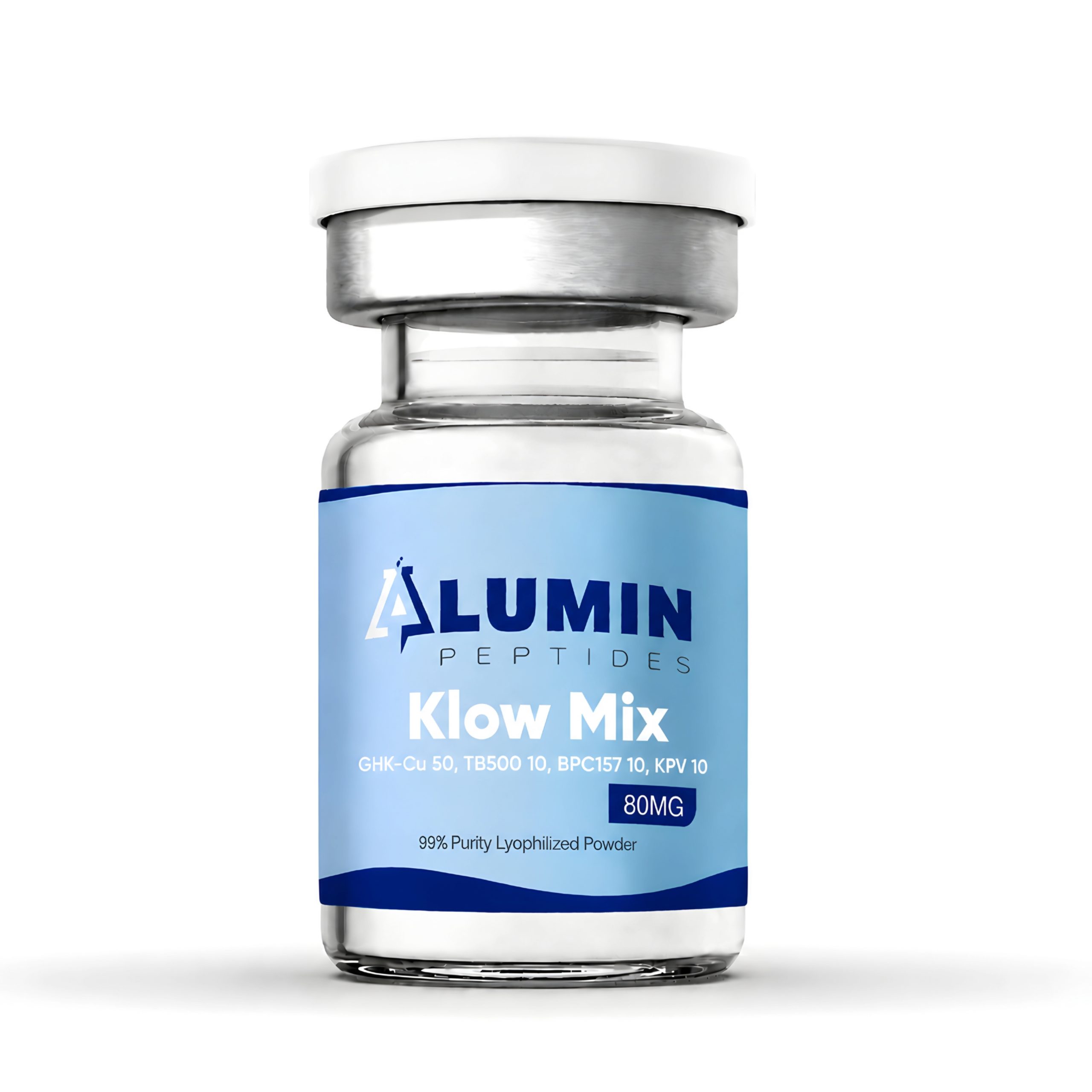
99% Pure Lyophilized Powder in 3ml vial (NOT A LIQUID) – If Reconstitution is desired, please purchase our Reconstitution Solution, HERE
Want a shortcut to research?

Dispatched Within 24 Hours

Referenced in Human Studies

Third-Party COA Verified

Sourced from Trusted Labs in EU

Scientific Advisory Oversight
Blend Ratio: 50mg GHK-Cu / 10mg TB-500 / 10mg BPC-157 / 10mg KPV
The complete recovery and resolution equation in one precision-formulated solution.
KLOW Mix expands on the foundational recovery blend by adding KPV — a potent anti-inflammatory tripeptide — to create a four-pathway approach to tissue regeneration research. Manufactured in our GMP-certified U.S. facility at 99% purity, KLOW Mix is designed to investigate the intersection of tissue repair, inflammatory resolution, and cellular environment optimization.
Blend Contents
- 50mg GHK-Cu
- 10mg TB-500
- 10mg BPC-157
- 10mg KPV
Store in a cool, dry place away from light.If Constituted, Please RefrigerateFor long-term storage, freezing at -20°C is recommended to maintain integrity.
The Science
GHK-Cu — Glycyl-L-histidyl-L-lysine copper regulates approximately 4,000 genes involved in tissue regeneration, modulates collagen and extracellular matrix production, and attracts stem cells and fibroblasts to sites of damage. GHK-Cu levels decline approximately 60% between ages 20 and 60, coinciding with measurable decreases in regenerative capacity.
TB-500 — A synthetic fraction of thymosin beta-4, present in virtually all human cells. Research published in the Annals of the New York Academy of Sciences demonstrated it accelerates cell migration to injury sites by 2–3 times and improves wound closure rates by up to 61%, while facilitating proper tissue architecture during the rebuilding process.
BPC-157 — A partial sequence of body protection compound found in gastric juice. Multiple studies have demonstrated its ability to enhance angiogenesis, upregulate growth factors essential for repair, and modulate nitric oxide pathways to improve microcirculation — creating optimal biochemical conditions for healing in tissues with naturally limited blood supply.
KPV — Lysine-Proline-Valine is a C-terminal tripeptide fragment of alpha-melanocyte-stimulating hormone (α-MSH) that retains the parent molecule’s anti-inflammatory properties without its melanotropic effects. KPV exerts its effects primarily through direct interaction with intracellular inflammatory pathway components, including NF-κB inhibition, independent of surface receptor binding. Research has demonstrated its ability to reduce pro-inflammatory cytokine expression in intestinal and systemic models, with significant attenuation of inflammatory markers in mucosal inflammation studies. Its small size and stability make it a well-suited research model for investigating peptide-mediated inflammatory resolution alongside tissue repair compounds.
The Four-Pathway Approach
- Information (GHK-Cu) — cellular reprogramming for regeneration
- Environment (BPC-157) — optimal biochemical and vascular conditions
- Action (TB-500) — execution of tissue rebuilding and cell migration
- Resolution (KPV) — inflammatory control to support the repair environment
For research purposes only. Not for human consumption or medical use.
Orders will typically be fulfilled to the following carriers within 24 hours of payment. USPS – (2 – 8 Business Days) UPS – (1 – 6 Business Days) *UPS HIGHLY RECOMMENDED*
Disclaimer: – This PRODUCT IS INTENDED AS A RESEARCH CHEMICAL ONLY. This designation allows the use of research chemicals strictly for in vitro testing and laboratory experimentation only. All product information available on this website is for educational purposes only. Bodily introduction of any kind into humans or animals is strictly forbidden by law. This product should only be handled by licensed, qualified professionals. This product is not a drug, food, or cosmetic and may not be misbranded, misused or mislabeled as a drug, food or cosmetic.
Frequently Asked Questions
Our local team are here to help
Have more questions about peptide research? You’re not alone. Explore our Frequently Asked Questions for quick answers—or head to the Knowledge Base to explore study areas, calculators, and protocol guides.